
It's a wonderful sunny day and it's a real shame to go underground. But how can I go caving in England when it rains?
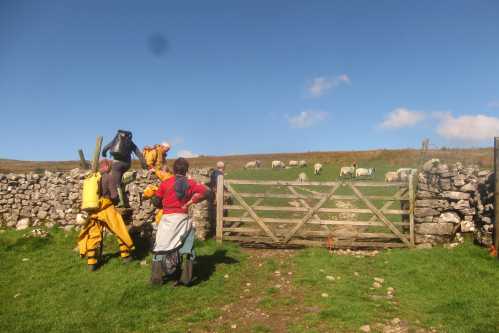
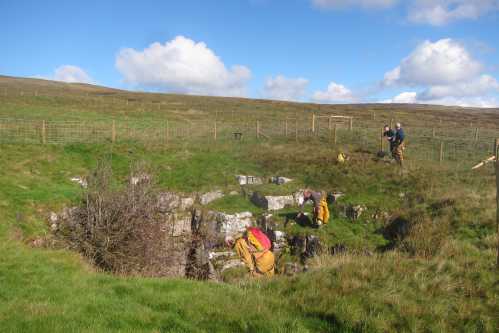
Nigel managed to excite 7 cavers for this trip which is a big success. After arrival to the entrance Nigel discovers that he left his helmet in car so he can enjoy the sunshine twice... Meanwhile Lionel starts rigging in such way that he misses instructions about the rope order in the tackle bags and riggs the first pitch. On average about 4 min/meter which...you can guess yourselves how much the ten meters pitch took. In any case, Nigel managed to walk to car and back and we were still on surface.
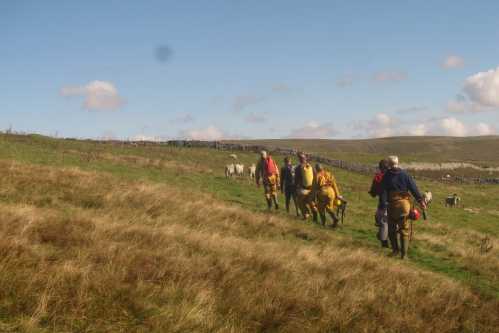
In the cave we make a quick progress to the main junction where we split into two groups. First group (Pete, Gordon and Susan) goes downstream with a tackle bag in order to bottom the cave completely down to the sump. The 2nd group goes upstream. I'm very surprised by dimensions and complexity of the cave. We enjoy all the cheeky crawls, cascades and waterfalls. The fun is over when we come to the duck. The water is quite cold but all of us make it through the duck. Beyond the duck all the beauties come. About 100 meters before the end of the cave Martin and Nigel decide to go out and me and Alex are determined to get to the upstream sump. We pass wonderfully decorated Blackstone chamber. On the way back we also visit second upstream sump.
When we come to the main junction we see that probably everyone is gone...but we still fancy visit the downstream part of the cave. In a speedy mode with a few navigation problems we managed to find a little keyhole in the floor which brings us to the picth leading to the downstream sump. With no ropes we just choke a stone down the pitch and make our steady way out of the cave.
In total: very nice cave with a variety of caving passages!
Party: I: Pete, Susan, Gordon
II: Ales, Alex, Martin J., Nigel
- - - - - - - - - - - - - - - - - -
gordona
Team Susan Pete GordonA
After Alex rigged the first pitch and found it just short I descended and added my much used 10m of 8mm.
Every caver should carry some!!!?? (Used fig 8 follow through Ian) so everyone got chance to abseil on 8mm 
Unfortunately I caught my suit and ripped the arse out of my meander. All for the sake of a 2"patch not working that I had glued on Friday night ,which had come off in Rowten the day before.  .
...........PJ was treated to a rare old view for the remainder of the trip, especially as I was wearing my two piece undersuit outfit rather than my one piece furry!! 
At the foot of the pitch I went round the first corner across the squeeze plus on your side slab with Alex to wait for everyone.
We caved as one team to the junction (which seemed soooooo much shorter than I ever remember before. I guess caving might get easier with experience? Where we split into two teams to speed things up.
We went down stream. I was confident I knew where the pitch was as last time Richard Rae was sat on top of it .....when we did n't have a rope/SRT kit to do it. This time armed with SRT kit and rope we were determined to do it -third or even fourth time into this cave.
Anyway we went to the end chamber. Found the keyhole on LHS. Went down this corkscrewy type downward passage and then onto sump. Over boulders, round boulders, under boulders, across holes through chambers etc etc. Through water. Down to where water disappeared.
Then started to go up upstream passage. Which just kept on going and going = lovely passage but no pitch???!!! After 30? mins we thought we d better go back and get the other team who went up stream; thinking they would have got back to the junction after only 10 mins of caving and be wondering where we were.
However when we got there we were surprised when they were n't there.
We waited a few mins then thought 'lets go upstream as well -to the boulder as we can't miss them'.
Pete and Susan opted to carry on and go under the boulder to look at the waterfall pitch was 5 mins beyond.
When they came back it was only 10 mins before Martin and Nigel appeared.
PJ /SB /me then headed out. Met another group coming in might have been Swaledale?
Came out to lovely sunshine. Waited for rest to appear. Martin gave impromptu lesson in tying a bowline on the bight - think I've got it now Martin!  /Damian.
Back to YSS for some left over Mexican = lovely!
Great day, good company, bad navigation (again) - Does this pitch actually exist?? ......We will be back again!!! Still lots more to explore. LoL
- - - - - - - - - - - - - - - - - -
11 September 2014 20:48 Ian Ball
Fig-8 follow through with different rope diameters? good thing it was just short haha
- - - - - - - - - - - - - - - - - -
gordona
I did think about different diameters..... but then Alex said 'a fisherman's would just pull tighter and tighter'......... 'Be impossible to separate'.
And there was about 7m left LoL. But no problem. 
- - - - - - - - - - - - - - - - - -
11 September 2014 22:55 John Brook
Gordon, I have to agree with Ian here. Fig of 8 follow through should not be used as a method of attaching two ropes of differing diameters, the knot can unravel before your eyes as you load below the knot. I gather you probably put stopper knots above and below the attachment but it is still not a safe method of attachment. Many years ago Chris Ellison who many of the members know and are aware of his capability on ropes used such a knot in Stream Passage. It unravelled and after he hit the hard stuff 30 feet below he was amazingly lucky only to have a badly fractured ankle. Messrs Elliott and Lawson were on the trip at the time as the three of them were putting together the rigging guide. It does go to show that even the extremely competent can make errors. Please look to using a different method of attachment with ropes of differing diameters.w
- - - - - - - - - - - - - - - - - -
12 September 2014 07:59 Ian Ball
The original Black Book of the Dales.
- - - - - - - - - - - - - - - - - -
12 September 2014 10:37 John Brook
Gordon, a double fishermans is, in my view, the safest knot to use in this circumstance. It's easy to tie and will not present problems if tied properly. Admittedly it can tighten but woul this matter if the rope is going back in a sack after derigging and can be untied at leisure back at the hut? Other knots can be used, an overhand or double overhand could be and is simple, less likely to slip than a fig8, but do use stopper knots. I believe our colonial cousins and leaders of the free world sometimes refer to this as a european death knot although I don't know why. Perhaps sounds more 'awesome' and is better if you are scripting a new stallone cliffhanger movie . The fig 8 tied through or any other way is not a safe knot to use, especially if not dressed properly and not dressing fig8's is something seen on most trips. Slippage if not dressed is much more likely. Sorry to return to this but feel its necessary for future safety.
- - - - - - - - - - - - - - - - - -
12 September 2014 10:46 John Brook
Tie the overhand or double overhand like you would a tape knot by the way, not like a 'single fishermans'. You could even easily and safely employ a butterfly as you would if isolating a section of damage mid rope on a bigger pitch, bit fancier but safe. Numerous suitable knots but NOT a through fig8.
- - - - - - - - - - - - - - - - - -
12 September 2014 13:26 Ian Ball
ooo an EDK debate!
I don't think there is much call for the Flat Overhand Bend in caving, if you're joining ropes to pruissik on then there are much better setups and if you like it because it's easy to tie, then you need to practice tying a better knot.
I'd have no problem using a fig-8 bend (ABok#1411) with double overhand stopper knots on equal diameter rope though.
If I plan on joining ropes and so pre-tie it, then I use an alpine butterfly bend with very long tails which I then double fishermans together which is what John mentions as fancy above
I know Damian uses a capuchin and double fishermans to join ropes and that's solid and quick, but the capuchin isn't a knot I'm overly familiar with, so I always think I'll try it and then decide to stick with what I know!
- - - - - - - - - - - - - - - - - -
12 September 2014 15:06 John Brook
No debate necessary Ian, didnt even realise there had been such things. However it can be tied safely but is not one I would use as there are better. A debate on something our cousins have such a daft name for though does sound like fun. Like one on the petzl 'descender of terror' or as we would call it a bobbin or simple. When i use the 'fancy' knot i always put the fishermans in first cos its easier to tie the butterfly(although should that be an alpine or a cavers variant, another debate coming on ) . Regardless in as much as the fig 8 is absolutely suitable for same diameter ropes, it is not for ropes of unequal diameter. Any views about in situ splicing of hawser laid hemp ropes as a way forward??
- - - - - - - - - - - - - - - - - -
12 September 2014 18:11 Ian Ball
What!!!?? There are two types of butterfly knot??
I don't think you've been lied to Alex, I just think the difference in rope diameter is more important than you may realise and in this case 7m of pitch would probably not be classed as heavy loading, unless you were really bouncing on your stop.
BCRAs Caving Practice and Equipment from 1991, the 1995 reprint says the following regarding Junction Knots.
Fig-8 Bend
A variation of the (reversed) fig-8 knot used to join the end of two ropes of equal diameter.
(use : joining similar ropes)
Double-Fisherman's
consists essentially of two `stopper' knots tied in opposition to each other in the ends of separate ropes. These are intended to slide together forming the knot proper. This is a very secure knot, used to join separate ropes, or both ends of the same rope to form a sling. It is prone to jamming under load and may in the worst case have to be cut from the end of the rope following particularly heavy loading. This tendency to jam, however, is a good point with a sling or a mid-pitch junction knot.
(use : joining ropes, making rope slings)
It then discusses the reef and double fishermans which is not as good as the butterfly to avoid overloading the DF knot as the butterfly forms the safety loop for passing it so is very compact and easy to pass in my eyes.
I'd be interested to read what the guideline in the CNCC rigging guide 2 is and Martin's thoughts?
- - - - - - - - - - - - - - - - - -
12 September 2014 23:41 John Brook
Hey , bearing in mind all the hard work Alex is putting in with UWFRA do you think he's trying to create and encourage his own client base.
- - - - - - - - - - - - - - - - - -
14 September 2014 20:38 Nigel Steel
Not a good weekend for me and the helmets 
- - - - - - - - - - - - - - - - - -
alexr
" Meanwhile Lionel starts rigging in such way that he misses instructions about the rope order in the tackle bags and riggs the first pitch. On average about 4 min/meter which...you can guess yourselves how much the ten meters pitch took. In any case, Nigel managed to walk to car and back and we were still on surface.
"
That's not very fair I was not given any instructions and one would expect the rope in the top of bag is for the first pitch!. It only took me 5 minutes to rig the darn thing. Not my fault the rope would not reach so I had to get Gorden to come down with a spare rope, having free climbed the remaining drop and declaring it unsafely loose. Keeping the other rope I had for the second pitch.
As far as I am aware I have been told by someone who knows what they are ddoing if it is heavily loaded a double fishermans knot will never come undone again, has someone been lying to me? I did not suggest which knot to use btw, I let Gordon make that choice as he could see what was going on and I could not. But yes the best way to do it would be a double fishermens isolated with an alpine or similar knot.
- - - - - - - - - - - - - - - - - -
16 September 2014 12:56 Ian Ball
I don't think you've been lied to Alex, I just think the difference in rope diameter is more important than you may realise and in this case 7m of pitch would probably not be classed as heavy loading, unless you were really bouncing on your stop.
BCRAs Caving Practice and Equipment from 1991, the 1995 reprint says the following regarding Junction Knots.
Fig-8 Bend
A variation of the (reversed) fig-8 knot used to join the end of two ropes of equal diameter.
(use : joining similar ropes)
Double-Fisherman's
consists essentially of two `stopper' knots tied in opposition to each other in the ends of separate ropes. These are intended to slide together forming the knot proper. This is a very secure knot, used to join separate ropes, or both ends of the same rope to form a sling. It is prone to jamming under load and may in the worst case have to be cut from the end of the rope following particularly heavy loading. This tendency to jam, however, is a good point with a sling or a mid-pitch junction knot.
Use : joining ropes, making rope slings)
It then discusses the reef and double fishermans which is not as good as the butterfly to avoid overloading the DF knot as the butterfly forms the safety loop for passing it.
I'd be interested to read what the guideline in the CNCC rigging guide 2 is and Martin's thoughts?
- - - - - - - - - - - - - - - - - -
gordona
Good advice guys. and editing Alex
Me just thinkin'..... 
If after doing the fig 8 follow through to join thin diameter onto the bottom of the 10mm..
- instead of using the 'normal' stopper knot that I did use (Alex) on the 8mm ..........if I had used a fishermans
wrapped the rope twice.....
.....then that would stop the thin fig 8 from puling out through the fig 8 on the thick rope.
What do ya think? 